

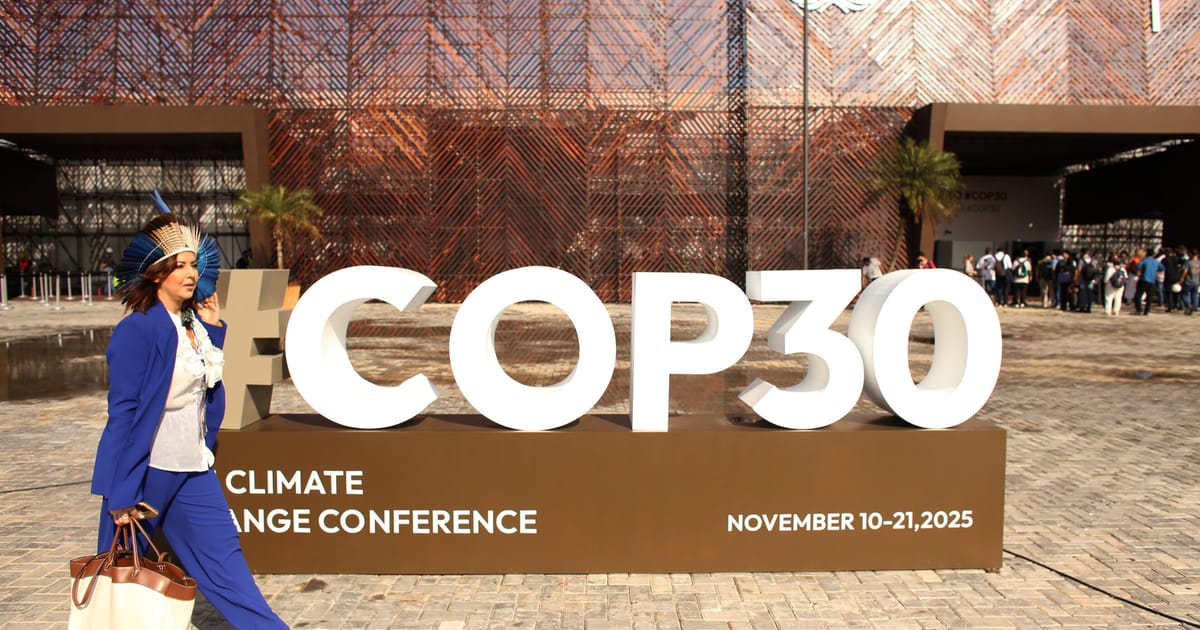
Belem, Brazil — As the clock ticks down on the final days of the 30th UN Climate Change Conference (COP30), the divide between wealthy and developing nations has sharpened into a deep mistrust. Delegates say that unless climate finance is fundamentally reshaped, the Paris Agreement’s promise of “justice” will remain out of reach. For countries like Tanzania, the political standoff is not an abstract diplomatic fight—it’s a looming economic crisis defined by shrinking GDP and rising climate-linked disease.
Inside the negotiation halls, the tension is high. Members of the G77 and China are resisting calls for greater climate ambition without matching commitments on finance. Their position is simple: the current global system is not delivering the resources needed for countries to survive climate impacts.
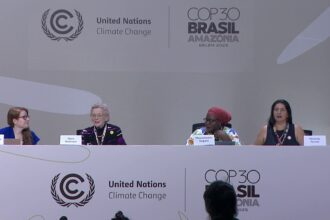
Speaking at a CAN International press conference on November 20, 2025, Avantika Goswami, Climate Change Programme Manager at the Centre for Science and Environment (CSE), said the current stalemate is rooted in past failures.
“Developing countries were let down… last year at COP29 in Baku. There was no accountability. There was complete mistrust in the multilateral process, as a result of which means of implementation remains a major sticking point,” she noted. “If we want to see more NDC ambition, we want to see a quicker transition, means of implementation has to be at the table.”
The economic and human cost
While negotiators haggle over wording in Belem, the consequences of delay are already being measured in Tanzania. A policy brief released by HakiRasilimali in June 2025 warns that the country could lose up to 4% of its GDP by 2050 unless climate-resilience actions are fully financed and carried out.
The risks stretch far beyond economic indicators. The brief estimates that as many as 13 million people could be internally displaced by 2050 due to climate pressures. These projections mirror the Tanzanian government’s own National Climate Change Response Strategy, which documents how shifting weather patterns are eroding existing social and economic safety nets.
One example is public health. According to the national strategy, malaria is now appearing in highland regions—Tanga, Kilimanjaro, Iringa, and Mbeya—that historically saw few cases, driven by rising temperatures. At the same time, national food production is expected to fall by 8–13% by 2050, putting strain on the 58% of Tanzanians whose livelihoods depend on agriculture.
More Read

At the same November 20 press conference, Pooja Dave, Policy Coordinator at CAN International, emphasized that these impacts turn technical negotiations into matters of survival.
“For those communities at the frontline, for the vulnerable communities, adaptation is not a choice, but it’s their only option, and it is their right, and right to survival,” she said. “If COP 30 really wants to deliver a justice package… then they must urgently adopt a new adaptation finance goal.”
A proposed path forward
To break the stalemate, civil society groups are championing the “Belem Action Mechanism” (BAM)—a proposed framework meant to move beyond promises and supply the technology, finance, and capacity countries need to move away from fossil fuels.
For Tanzania, this kind of support is essential. The country depends on natural gas for more than half of its electricity but also holds significant reserves of critical minerals such as nickel and graphite. A well-funded transition could help Tanzania build a green industrial base instead of remaining a raw-materials exporter.
More Read

At the Belem briefing, Dr. Amiera Sawas, Head of Research and Policy at Fossil Fuel Treaty, said the mechanism is key to ensuring global progress happens fairly.
“We need to transition away from fossil fuels in a just, equitable and orderly way… doing this requires support for nations across the global south to make this a reality,” she explained. “We really believe that the transition away from fossil fuels roadmap that’s being discussed will need the Belem action mechanism to stand a real chance of succeeding.”
The battle over “ambition”
One of the most contentious debates at COP30 centers on the claim by developed nations that the Global South is not showing enough ambition in its climate plans. Wealthy countries have used this alleged “ambition gap” to justify withholding financial flows.
Critics call this argument a diversion. They point to detailed, costed strategies from countries like Tanzania—including the National Climate Change Response Strategy and the Livestock Master Plan—that remain unimplemented only because the required funding has not arrived.
Goswami warned that this narrative could be weaponized.
“We will see a lot of scapegoating in the coming days… Large developing economies will be put in the spotlight for not doing their part, not putting up ambitious NDCs,” she said. “And that will be the argument that will be used to hold back adaptation finance for the entire African continent… So let’s all remember this argument is completely bogus.”
The stakes remain high
As the conference draws to a close, the gap between what Global South countries are calling for and what developed nations are offering remains big. Without a major shift in climate finance, Tanzania may be forced to confront a 4% GDP loss and mounting public-health threats with little more than unmet pledges.